What Does a "Quality First" Commitment Really Mean in Manufacturing?
You see "Quality First" in every supplier's brochure, but you still worry about hidden flaws. The slogan feels empty when a single faulty component can jeopardize your entire project.
"Quality First" isn't a marketing slogan; it's an operational philosophy. It means building a culture where quality is the primary driver of every decision, from hiring people to choosing processes.
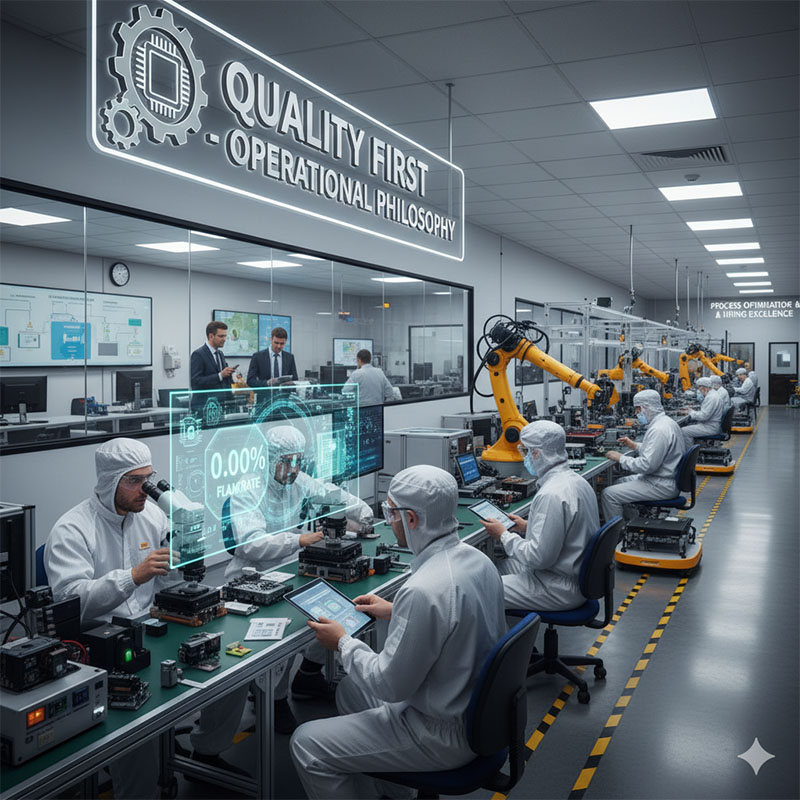
I'll never forget a moment from about five years ago. I was walking the factory floor and saw one of my most experienced machinists, a guy named David, shut down his CNC machine mid-cycle. This is a big deal; it stops production. I walked over, expecting a machine fault. Instead, he showed me the tiny metal shaving coming off the part. The color and shape were slightly off. He said, "Mike, the tool is starting to dull. It's still within spec, but it's not perfect. I'm changing it out." He could have let it run for another hundred parts before it caused a real issue. But his standard wasn't just "within spec," it was "perfect." That moment defined "Quality First" for me. It's not about a final inspection catching mistakes; it's about a culture where every person prevents them from ever happening.
Why Is Our Team Our Strongest Quality Guarantee?
You work with suppliers where operators seem disengaged. This lack of ownership means subtle defects are missed, leading to inconsistent and unreliable parts reaching your assembly line.
Our team members are our first and most important quality control system. We hire and train them as craftspeople who understand the "why" and are empowered to ensure perfection.
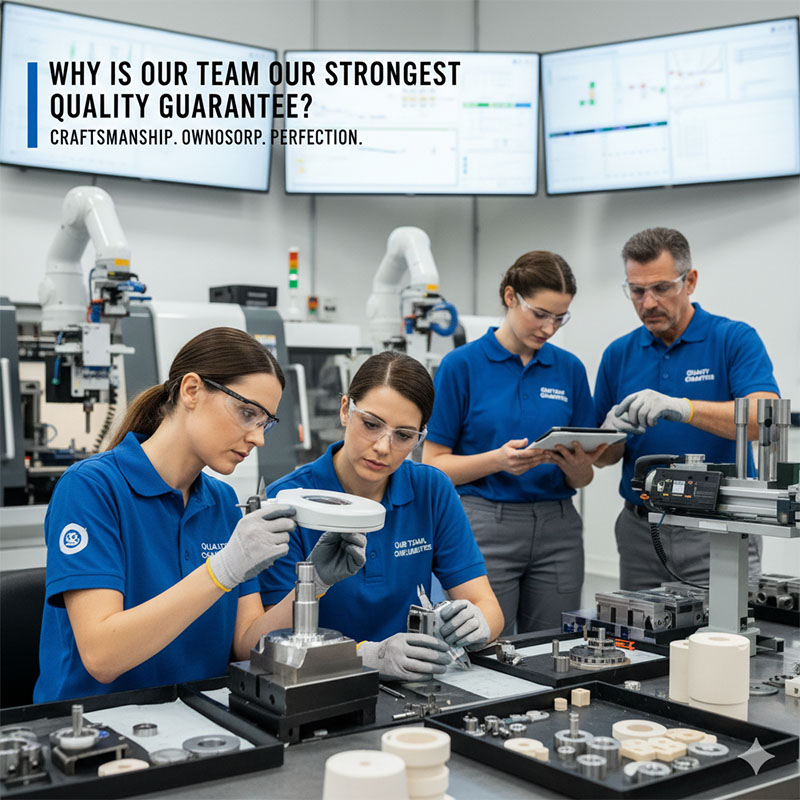
You can have the most advanced machines in the world, but they are only as good as the person operating them. In many factories, the goal is to make operators interchangeable, just cogs in a machine. We take the opposite approach. We invest heavily in training people to be true craftspeople. They don't just learn which button to press; they learn to read the machine. They listen for changes in the sound of the cutter, they look at the texture of the machined surface, and they understand why a specific tolerance matters to your design, Jacky. This "craftsman's mindset" is crucial. It turns a passive operator into an active guardian of quality. They don’t just make parts; they take personal pride in knowing that the part they made is going into a critical system and must be flawless. They are our partners in quality, not just our employees.
The Operator vs. The Craftsman
| Trait | Standard Machine Operator | MoldAll Craftsman |
|---|---|---|
| Goal | Meet quota | Achieve perfection |
| Focus | Following instructions | Understanding intent |
| Role in Quality | Relies on final inspection | Owns quality at the source |
| Empowerment | Reports problems | Prevents problems |
Why Do We Intentionally Choose Slower, More Deliberate Processes?
You're constantly pushed for faster turnarounds and lower costs. This pressure forces suppliers to take shortcuts, often leading to parts that fail long before they should.
We believe that true speed comes from a stable, perfect process, not from rushing. By focusing on doing it right the first time, we eliminate the costly delays of rework and failure.
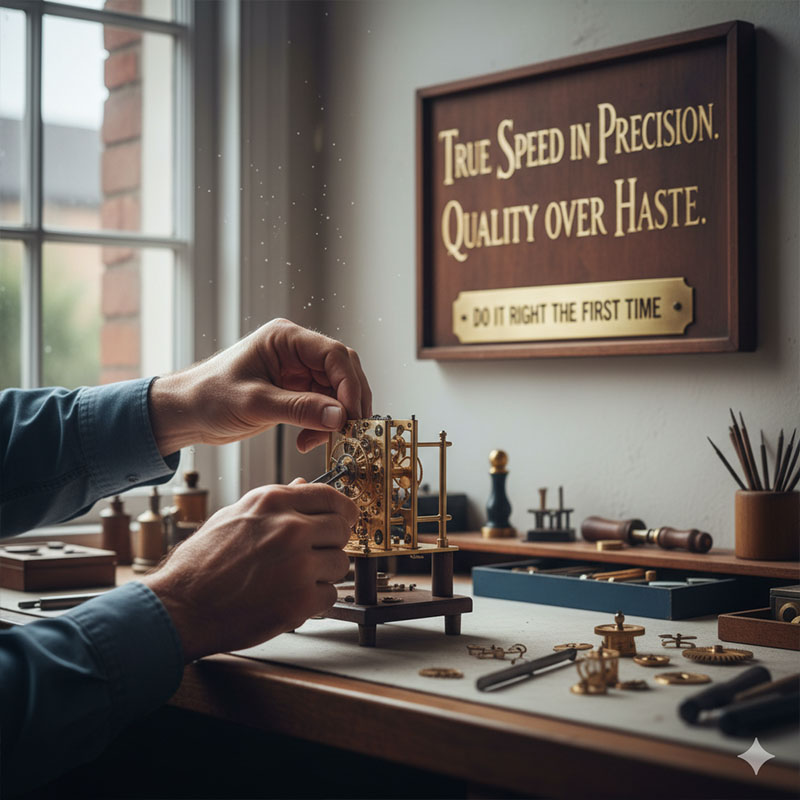
The modern manufacturing world is obsessed with speed. Everyone wants things faster. But rushing is the enemy of quality. When you run a CNC machine at its absolute maximum speed, you introduce vibrations that can ruin a critical surface finish. When you use a cutting tool until it's completely worn out to save a few dollars, the last parts you make with it will be out of tolerance. We intentionally build deliberation into our process. We might run a machine at 90% of its top speed to guarantee a perfect finish. We change our cutting tools much more frequently than the industry average because we know a sharp tool creates a cleaner, more precise cut. This might seem "slower" on a per-part basis, but it's infinitely faster overall. We don't have to waste time sorting out bad parts, and more importantly, you don't waste time and money dealing with failures in the field.
The True Cost of Rushing
### Sacrificing Precision Pushing machines to their limits creates "tool chatter" and heat buildup, leading to poor surface finishes that destroy seals and out-of-tolerance dimensions that cause leaks.
### Ignoring Process Health A deliberate pace allows our craftsmen to observe the process, catch potential issues early, and make adjustments. Rushing means you only see the problem after a batch of bad parts has already been made.
How Does Our Commitment to Quality Extend Beyond the Factory Floor?
You receive a part, but its history is a mystery. If a problem arises, there's no way to trace the root cause, leaving you exposed to the same failure again.
Our commitment includes total transparency. We provide complete part traceability, giving you a direct line of sight from the finished part in your hand back to the raw material it came from.
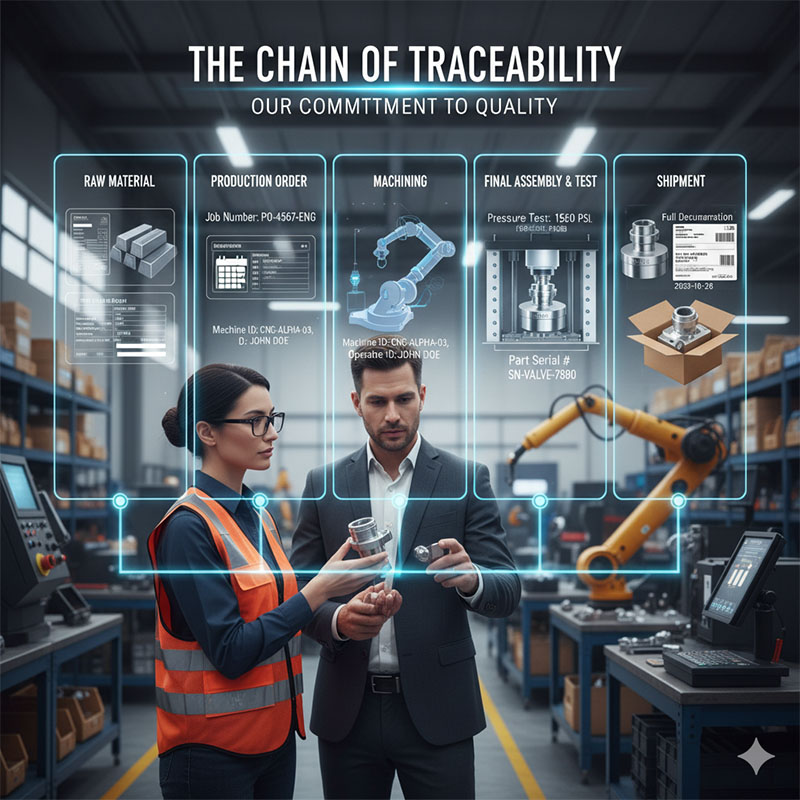
Our responsibility doesn't end when a part is shipped. A "Quality First" commitment means giving you the data to have complete confidence in our products. This is achieved through rigorous traceability. Every single valve and fitting we produce is marked with a unique serial number. This number is not just for show; it's a key that unlocks the part's entire life story. We can instantly pull up the records showing the original Mill Test Report for the raw material, which machine it was made on, which operator ran the job, the date of production, and the detailed results from its final pressure test. For a designer like you, Jacky, this is a powerful tool. It provides an unbreakable chain of accountability. If there is ever a question about a part's performance years down the line, we can analyze its history together to understand every variable. This is what transforms a supplier relationship into a true quality partnership.
The Chain of Traceability
- Raw Material: MTR (Mill Test Report) is logged.
- Production Order: A unique job number is assigned.
- Machining: Machine ID and Operator ID are recorded.
- Final Assembly & Test: The part is serialized and test results are logged.
- Shipment: The serialized part is shipped to you with full documentation.
Conclusion
Our "Quality First" commitment is our promise. It's a culture of craftsmanship, deliberate processes, and total transparency, ensuring every part we make is one you can trust completely.